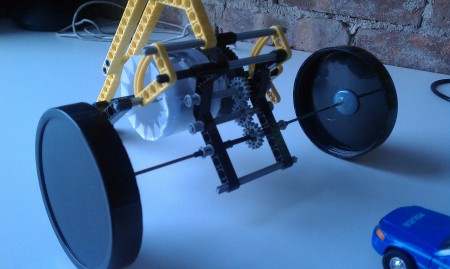
Lego model of spring steel coil powered car
While we were brainstorming on ways to power our car I did some research on using the spring steel coil method of powering a car, where a coil of spring steel is rolled up, and wound tightly, so when released it quickly uncoils, and propels the car forward. This system is frequently used in toy cars that you wind by pulling backwards and then release.
I made this Lego model, simulating the spring steel coil with wound plastic sheet, which although with very little force, also tends to unwind or “spring” out.
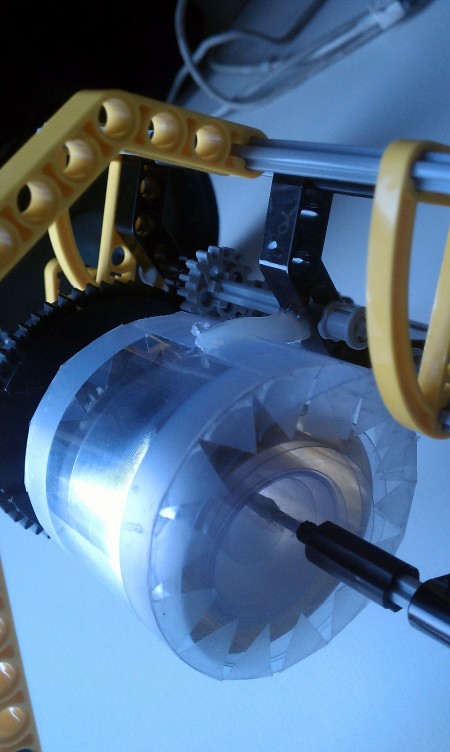
A long and narrow sheet of clear plastic is wound up inside of this cylindrical container, with one end attached to the center shaft, and the other to the outside of the cylinder. One side of the cylinder has a large fixed gear that turns with the cylinder. The shaft is fixed, and when the cylinder is wound around, it tends to spring back to unwind the spring steel, turning the large gear with it, which in turn turns other gears, and eventually the wheels.
When I opened up one of those toy cars, I noticed that one of the most complicated part of the mechanism was the part that switches between gears so that when the wheels are going backward the coil is winding, and when they are going forward it is allowed to unwind. In our case this would not be necessary, since we could wind with some sort of ratchet at the starting line, and then release to propel forward.
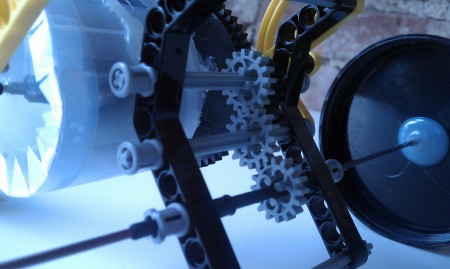
In this image you can kind of see how the main large black gear is turning the top gear, which turns the middle gear, which turns the bottom gear attached to the wheel shaft. The middle gear sits on a shaft, unlike the other shafts, that has the ability to move a little up and down within the lego piece, hence it is a free, not a fixed, gear. When the spring coil is completely unwound, or at any point when the momentum of the wheel shaft is faster than the movement of the coil shaft, the momentum of the wheel shaft begins to turn the middle gear that connects the wheel shaft to the coil shaft, and as soon as this happens, the middle (free) gear moves up with its shaft just enough that it fails to grip to the wheel shaft, which in turn is free to turn with its own momentum.
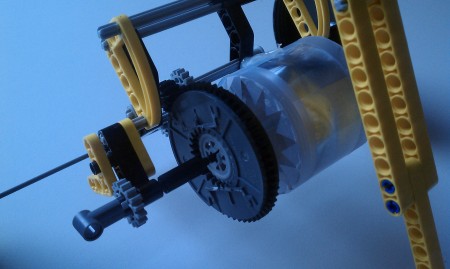
The left most piece with the small gray gear and the hole is the ratchet, where a pole can be placed inside to help gain leverage to turn the shaft and wind the spring steel. The yellow cog on the left helps to keep the gear from turning the other way and unwinding the coil. After it is wound all the way it can be released to propel the car by lifting the yellow cog.
In the end my team wanted to focus entirely on the slingshot idea, but figuring this out was very educational. The biggest challenge is allowing the car to keep going forward after the spring was completely unwound, like the free gear in a bike that allows the bike to keep going even when you stop pedaling.